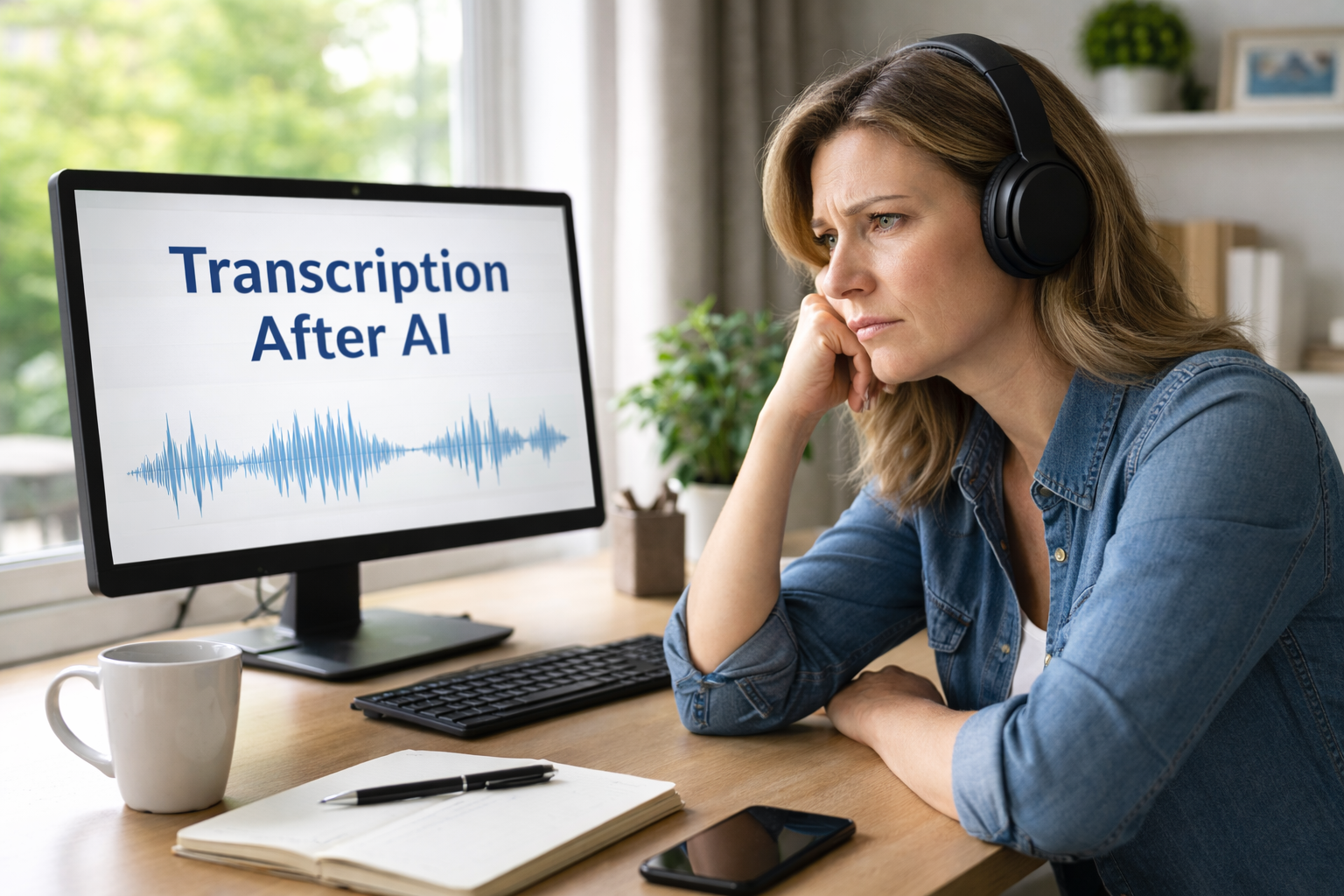
Yes, it is true. AI is here to stay. That reality has left many people wondering what comes next for transcription after AI. Is it still a viable career, or does it simply require a different approach than it did before?
These questions are everywhere. They show up on job boards, in forums, and across social media, often revealing uncertainty or fear rather than facts. Ignoring that concern only deepens mistrust, which is why it deserves to be addressed directly.
The truth is this: AI has changed how transcription is done, but it has not removed the need for human review. Accuracy, context, and reliability still depend on it.
What AI Can and Cannot Do in Transcription
I have been writing about transcription since 2006, but it was not until 2018 that I was first introduced to artificial intelligence in videotelephony. That period marked the point when many transcriptionists began to question whether AI would eventually eliminate their work altogether.
There is no denying that AI is a remarkable technology. Businesses are drawn to it for three primary reasons: speed, scalability, and cost effectiveness.
AI can process large volumes of audio far more quickly than a human and can operate continuously, day and night. It can also scale effortlessly, handling thousands of hours of content without fatigue or scheduling constraints. For large projects, AI can be significantly less expensive than hiring and coordinating multiple people.
These strengths make AI useful, particularly for first-pass transcription or low-risk content. However, they also reveal clear limitations.
AI does not understand meaning, intent, or consequence. It cannot judge whether a transcript is accurate in context, whether speakers have been correctly identified, or whether an error could create confusion or risk. For that reason, AI-generated transcripts still require human review to correct mistakes, resolve ambiguity, and ensure the final output is reliable.
This is where the role of human transcription shifts rather than disappears.
Where Human Transcription Still Wins
Once AI-generated transcripts are reviewed in real-world settings, their limitations become more apparent. “Human transcriptionists can reach 99 percent accuracy, while some AI transcription platforms were measured at only 61.92 percent” (Ditto, Oct. 21, 2025).
Human transcription continues to outperform AI in areas that require judgment rather than pattern recognition. These include speaker differentiation, understanding accents and managing overlapping speech. In addition, recognizing context and applying industry-specific knowledge in legal and medical environments are areas in which humans excel. Human reviewers also provide essential quality control, catching errors that automated systems cannot recognize on their own.
If you want a deeper breakdown, here are nine real reasons human transcriptionists still outshine AI in practice.
What the Future of Transcription Looks Like
AI’s limitations do not mean transcriptionists should avoid using it. In fact, used correctly, AI can support efficiency rather than threaten it. Imagine AI handling the initial task of listening to the audio and producing a rough transcript.
Once AI has finished, you take control. Human review, correction, formatting, and certification remain essential parts of the process. This is where judgment, accuracy, and accountability come into play.
This is how transcriptionists shift from purely transcribing to working within a hybrid process in which you and AI work on the same transcription. Your role evolves into editor, verifier, and specialist, rather than disappearing altogether.
In this model, the stress of being replaced gives way to adaptation and responsibility.
Why Training Matters More Now, Not Less
The importance of transcription training cannot be overstated. The intricate work involved in human review, correction, formatting, and certification does not happen automatically. These skills are developed over time through structured learning and practice, especially in a competitive industry.
When tools change, skill gaps widen. Without proper training, people are left guessing. Structured transcription training teaches how to work with AI rather than compete blindly against it. Transcriptionists who use technology effectively while maintaining accuracy will continue to be in demand.
Skills that are becoming increasingly important include:
- Language mastery, including grammar, spelling, and punctuation
- Keen listening skills that support understanding tone, intent, and emphasis
- Critical thinking to recognize when AI output is incorrect and how to fix it
- Formatting expertise to meet strict client style guides
- Adaptability to learn new tools and stay current with evolving technology
While certification is not always required, transcription skills can be learned through community colleges, university degree programs, and specialized online platforms. If you choose to pursue professional certification, the American Association of Electronic Reporters and Transcribers (AAERT) is widely recognized for its education and certification programs supporting digital reporting and transcription professionals.
AAERT maintains a list of approved schools and courses that can help transcriptionists advance their careers. One such training provider I am familiar with is Transcribe Anywhere.
A Thoughtful Way Forward
For those who have been watching these changes closely, this moment can feel unsettling. AI has introduced new tools, new workflows, and new questions about the future of transcription. But uncertainty does not mean instability.
If you have been on the fence about whether transcription is still worth pursuing, this is one of those periods where preparation matters more than guessing. Understanding how transcription works after AI adoption, and how human review fits into that process, provides clarity and confidence in an evolving industry.
The future of transcription is not about fearing technology. It is about knowing how to work alongside it, applying judgment where it matters, and building skills that remain valuable regardless of the tools involved.
Updated on 3/24/2026
Pam Lokker is the founder of Borlok Virtual Assistants, LLC and the creator of Borlok Transcription, where she helps new and aspiring transcriptionists build confidence, learn industry standards, and understand the business side of transcription. With decades of experience in freelance services, she provides clear, practical guidance to those pursuing work in transcription, proofreading, and scoping.