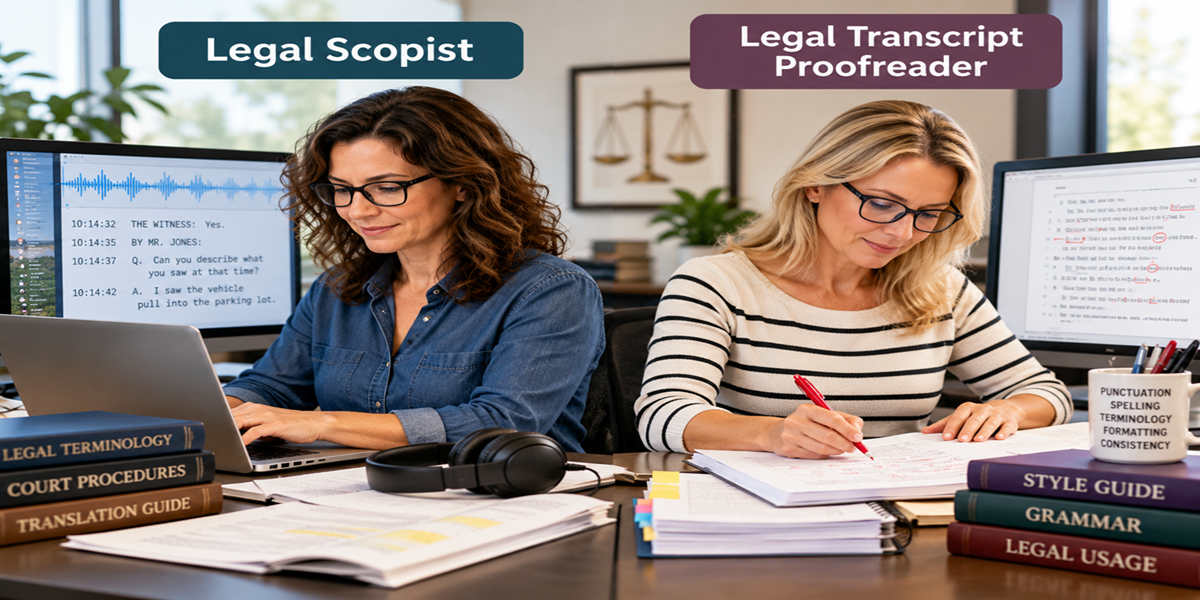
A legal scopist and a legal transcript proofreader sound as though they could be the same thing, don’t they? They are not. While both help court reporters produce accurate transcripts, they perform different functions.
The court reporter listens to spoken words and uses a steno machine to record them into shorthand. Computer-aided transcription (CAT) software then translates the shorthand into English.
It would be nice if the raw text were 100% accurate. However, that is not always the case. A scopist reviews the translation and looks for anything out of place. These could be punctuation errors, incorrect formatting, or mistranslations. If necessary, the proofreader picks up the process by performing a quality check after the scopist completes their role.
The exact division of work can vary depending on the court reporter’s workflow.
At first glance, people can confuse these roles because they can sound so similar. Scopists and proofreaders look for errors, but only if the reporter needs them. Both help court reporters produce a polished and accurate final transcript.
But they aren’t interchangeable.
The biggest difference isn’t simply that one edits and the other proofreads. It’s where they work in the transcript-production process and what they’re responsible for checking.
What Does a Legal Scopist Do?
When I first started in the transcription industry in 2006, I took the time and effort to learn the varied transcription-related fields in the legal industry, and even learned more from a legal scopist expert.
NCRA describes a scopist this way:
“A scopist is a professional transcript editor for court reporters. However, unlike an editor or a proofreader, a scopist has the ability to compare a court reporter’s shorthand to the finished transcript. By “scoping” the transcript, mistranslate errors can be identified, thereby helping the court reporter preserve an accurate record.”
A scopist could be doing many different tasks:
- Working with the reporter’s translated stenographic notes
- Identifying mistranslates
- Editing the transcript
- Performing research as needed
- Checking punctuation, spelling, grammar, terminology, and consistency
- Adhering to the court reporter’s preferences
- Using computer-aided transcription (CAT) software
Scoping is not the same as copyediting and requires specialized training. You can see the areas that are different in the table below:
| Scoping versus Copyediting Comparison | ||
|---|---|---|
| Feature | Ordinary Copyediting | Scoping |
| Primary Material | English text | Translated stenographic notes, sometimes with audio |
| Objective | Detect and mark grammatical, typographical, and compositional errors for correction | Help produce an accurate transcript of the spoken record |
| Handling Mistakes | Corrects clear errors and queries the author when a change could affect the intended meaning | Corrects mistranslates and other transcript errors while following the reporter’s preferences |
| Tools Used | MS Word or Google Docs with the ability to track changes. Style guides (in-house and external) and reference books | CAT software (e.g., CATalyst Edit, Eclipse, StenoCAT) |
| Industry Focus | Publishing, marketing, journalism | Legal |
Does a Scopist Listen to the Audio?
Not necessarily. Whether a scopist listens to the entire audio recording can depend on the court reporter’s preferences, but it can be an important tool for a scopist. It can help clarify testimony, identify missing or incorrect words, distinguish between speakers, and resolve portions of a transcript that aren’t clear from the translated stenographic notes alone.
However, no single workflow applies to every court reporter and scopist.
The roles are different, but the way the work is divided can vary. A court reporter may scope their own transcript, work with a scopist, choose a proofreader, or work with both a scopist and a proofreader.
Whether audio is required should be clarified at the beginning of the court reporter/scopist relationship.
What Skills Does a Scopist Need?
According to Stenovate, scopists need a solid command of English and an understanding of how spoken testimony should be punctuated in a legal transcript. They also need to know how to work with court-reporting CAT software.
Other useful skills include:
- Strong listening skills
- Research skills using specialized resources
- Ability to work well with others
- Ability to follow a court reporter’s style preferences
Now that we have looked at the role of a legal scopist, let’s look at a legal transcript proofreader.
What Does a Transcript Proofreader Do?
We touched on the relationship a court reporter has with both positions:
Court reporter → scopist → proofreader → finished transcript
Not all court reporters follow this same process. This means a court reporter may not require a scopist or a proofreader.
The transcript proofreader generally provides a later quality check after a legal transcript has been edited and looks for errors that may have been overlooked during the earlier stages of scoping.
For example, Christina Petrides, a legal transcript proofreader who works with U.S. court reporters, describes some of the most common errors she finds as typos and missing or misplaced punctuation. She also looks for problems such as inverted words, homophones, doubled words, and errors involving proper nouns or unfamiliar terminology.
Research can also be part of the job. Petrides explains that she uses resources such as Merriam-Webster and Google to check place names, proper nouns, unfamiliar spellings, and industry jargon.
Remember in our chart above that proofreading a legal transcript isn’t the same as copyediting an article or business document. A proofreader isn’t there to rewrite someone’s testimony or make awkward speech sound better. The goal is to catch possible errors while preserving the spoken record.
The proofreader will alert the court reporter to anything that doesn’t look right.
Does a Transcript Proofreader Listen to the Audio?
A proofreader may notice something in the written transcript that doesn’t seem right, but that doesn’t automatically mean the proofreader checks it against the audio.
Petrides provides a good example. When punctuation could change the meaning of a passage, she leaves a note asking the court reporter to check the audio rather than making that determination herself.
That doesn’t mean a proofreader never listens to audio. A court reporter may ask a proofreader to check audio as part of their established working arrangement. As we’ve already seen with scoping, workflows can vary from one court reporter to another.
What Skills Does a Transcript Proofreader Need?
Legal scopists and transcript proofreaders share some foundational skills, but each role requires a different set of specialized skills.
Franklin University’s Career Guide analyzed 1,689 job postings associated with legal proofreading and related proofreading occupations. Among the most frequently requested common skills were grammar, writing, communication, attention to detail, and English language skills.
What Is the Proofreader’s Role in the Transcript Process?
By the time a transcript reaches the proofreader, it has already been through the court reporter’s hands. And if a scopist is part of the workflow, it has already been edited. The transcript proofreader provides another set of eyes to catch errors that may have slipped through earlier reviews.
But unlike ordinary proofreading or copyediting, the proofreader isn’t trying to improve the speaker’s wording. The goal is to help catch remaining errors while preserving an accurate record of what was said.
Attention to Detail
Even small errors in a legal transcript can matter. Grace Pirozzi, the owner of Pirozzi & Hillman in New York, N.Y., explains why:
“A transcript is a permanent record, not a draft. Every misplaced comma, misheard name, or missing “not” has the potential to affect the record. Proofreading ensures the transcript reflects what was actually said.”
A skilled legal proofreader looks for missing or misplaced punctuation, typos, doubled or omitted words, homophones, incorrect proper nouns, and inconsistencies that survived earlier editing.
But attention to detail also means recognizing when something doesn’t look right and bringing it to the court reporter’s attention rather than making assumptions.
Working With the Court Reporter
Technical proofreading skills are only part of the job. A transcript proofreader also needs to learn how an individual court reporter wants the work handled.
There is no one-size-fits-all approach to how court reporters want to receive corrections and questions. Many will give the proofreader a breakdown of their preferences, but that is not always the case. In that case, a good practice would be to get that information up front.
Other clarification points can include formatting preferences, whether audio is available, how questions should be addressed, and when completed transcripts need to be returned.
Scopist vs. Transcript Proofreader: Side-by-Side Comparison
Although scopists and transcript proofreaders both contribute to transcript quality, they usually work at different stages of the production process and perform different types of review.
| Scoping versus Legal Transcript Proofreader Comparison | ||
|---|---|---|
| Feature | Legal Scopist | Transcript Proofreader |
| Primary role | Edits the transcript | Performs a later quality check of the edited text. |
| Stage of process | Earlier | Usually later |
| Works with stenographic notes | Yes | Generally no |
| Identifies mistranslates | Yes | May flag possible errors |
| Uses CAT software | Commonly | Not necessarily |
| Works with audio | Possibly, depending on the court reporter’s preferences | May, depending on the arrangement |
| Works directly with court reporter | Yes | Often |
| Specialized transcript knowledge | Yes | Yes |
| Deadline management | Yes | Yes |
Why Do Court Reporter’s Preferences Matter?
“Court reporters are highly trained professionals who share a unique ability to convert the spoken word into information that can be read, searched, and archived. Court reporters save time, are cost-effective, and provide quality results through the use of cutting-edge technology.” (National Court Reporters Association (NCRA)
The U.S. Bureau of Labor Statistics (BLS) provides some additional context.
Court reporters create word-for-word transcriptions of trials, depositions, administrative hearings, and other legal proceedings. Their responsibilities may include identifying speakers, recording gestures and actions, reviewing names and technical terminology, and providing transcripts and recordings to the parties involved.
Most importantly, court reporters are responsible for producing a “complete, accurate, and secure transcript” of legal proceedings.
That responsibility helps explain why individual court reporters may develop their own workflows and preferences for preparing a transcript.
What Can a Court Reporter’s Preferences Affect?
Workflow, responsibilities, deadlines, formatting, communication, technical issues, and the use of audio may depend on the working relationship between the court reporter and the scopist or proofreader.
Practical differences may also exist from one reporter to another. BLS reports that many court reporters are self-employed freelancers who are hired by law firms or corporations for depositions and other proceedings. Others work in courts, legislatures, government, or business support services.
The work itself can be demanding. BLS notes that court reporting may be stressful because of the speed and accuracy required to produce a verbatim record and the time-sensitive nature of legal proceedings.
That means someone entering scoping or transcript proofreading needs more than technical skills. They also need to learn how to work with an individual court reporter and follow that reporter’s preferences.
What Reference Resources Do Scopists and Transcript Proofreaders Use?
Which resources they use may depend on the court reporter’s preferences, the type of proceeding, and the subject matter involved.
Reference resources include:
- Court Reporting: Bad Grammar/Good Punctuation by Margie Wakeman Wells for punctuation and transcript-related grammar questions.
- Merriam-Webster and other established dictionaries for spelling, capitalization, word usage, and hyphenation.
- Specialized dictionaries and reference materials when a proceeding involves legal, medical, technical, or other industry-specific terminology.
- The court reporter’s preference sheet or style guide, when provided, for individual preferences that may differ from general reference rules.
- Reliable online sources for verifying proper names, businesses, locations, medications, products, organizations, and terminology that may not appear in a traditional dictionary.
Knowing where to look is only part of the job. A scopist or transcript proofreader must also determine which source fits the question at hand.
A reference book can tell you the generally accepted way to handle something, but the reporter may have established preferences for how the transcript should be prepared.
What Tools and Software Do Scopists and Transcript Proofreaders Use?
Scopists and transcript proofreaders may use different tools because they perform different types of work on a transcript.
What Software Do Legal Scopists Use?
A legal scopist typically works with computer-aided transcription (CAT) software. This allows the scopist to work with the court reporter’s transcript file and make corrections during the scoping process.
Examples include:
Case CATalyst Edit: Stenograph provides CATalyst Edit for scopists and proofreaders working with CATalyst transcript files. It includes editing, dictionary, global correction, AudioSync, and proofreading functions.
Eclipse Edit: Advantage Software describes Eclipse Edit as scoping software. The company says it performs the functions of Eclipse CAT software except those related to translation and includes editing and collaboration features.
ProCAT Winner Scopist Edition: ProCAT describes its Scopist Edition as software for professional scopists, proofreaders, and transcriptionists. Its features include transcript editing, formatting, dictionaries, audio synchronization, and proofreading tools.
StenoCAT for Scopists: Gigatron Software offers a StenoCAT version specifically for scopists that supports transcript editing, proofreading, dictionaries, globals, and synchronized audio playback.
Now let’s take a look at what software a legal transcript proofreader might use.
What Software Do Transcript Proofreaders Use?
Depending on the court reporter’s preferences, a proofreader may review in a CAT program or mark corrections on a PDF.
PDF annotation programs can provide highlighting, comments, insertion and deletion marks, and other tools useful for marking corrections. However, current authoritative sources don’t establish one PDF application as the standard software used by transcript proofreaders.
The workflow can also change when a proofreader is asked to proof to audio. In that situation, the proofreader listens to the recording while checking the transcript and may use headphones and a foot pedal to make audio playback easier to control.
Technology can also connect the court reporter, scopist, and proofreader as a transcript-production team.
How Do Scopists and Proofreaders Collaborate With Court Reporters?
Advantage Software’s Connection Magic provides collaboration within Eclipse, allowing multiple team members to work in the same document over the internet.
These tools can be especially useful for expedited or real-time work because editing and proofreading don’t have to wait until the reporter has finished producing the entire transcript.
Other tools support the workflow surrounding the transcript rather than the editing itself. Stenovate, for example, is designed for court reporters, scopists, and proofreaders to exchange files, manage assignments and deadlines, communicate, and track a transcript’s progress.
The technology may differ, but the underlying workflow is similar: The court reporter, scopist, and proofreader can work as a team while still performing different roles in producing an accurate final transcript.
The important point isn’t which software brand a scopist or proofreader prefers. It is whether the tools fit the court reporter’s workflow and allow the professional to review and return the transcript in the format the reporter expects.
Do You Need Training or Certification?
Based on my research for this article, I did not find a generally required professional certification for either legal scopists or transcript proofreaders.
Professional certification does exist within the court reporting industry. For example, NCRA offers the Registered Professional Reporter (RPR) certification for current or aspiring stenographic court reporters. But professional certification such as the RPR should not be confused with completing a training program for scoping or transcript proofreading.
***Disclosure: This post and our website contain affiliate links. I receive a small amount of money when you purchase using one of my links. Please see our affiliate disclosure.***
Training can help you learn the specialized skills involved in either role. Internet Scoping School, for example, offers training for prospective scopists, while Proofread Anywhere offers training in transcript proofreading.
Why Specialized Training Can Matter
Neither scoping nor transcript proofreading is simply a matter of being good at grammar and punctuation.
As we’ve seen throughout this article, scopists work with translated stenographic notes, identify mistranslates, use CAT software, and follow the individual court reporter’s preferences. Transcript proofreaders also need to understand the legal transcript workflow and recognize when something should be flagged rather than changed.
Are a Certificate and Certification the Same?
This is where terminology can become confusing.
A training program may provide a certificate when you complete its coursework. That certificate shows that you completed that particular program. It should not automatically be interpreted as a professional certification required by the scoping or transcript-proofreading industry.
That’s why, if you’re comparing training programs, it’s important to look beyond whether you’ll receive a certificate. Look at what the program teaches and whether the training prepares you for the actual work you’ll be doing.
Can You Work as Both a Scopist and a Proofreader?
Yes. Scoping and transcript proofreading are different stages of transcript production, but one person can offer both services.
For example, Melissa Wilson identifies herself as a professional proofreader and scopist for court reporters and offers both services.
Scoping requires the skills needed to work more deeply with the transcript during production, including CAT software and translation issues.
Transcript proofreading, on the other hand, requires the meticulous review we’ve discussed throughout this article.
If you’re interested in doing both, you would need to develop the skills required for each role.
How Do Scopists and Transcript Proofreaders Find Work?
Finding work as a scopist or transcript proofreader may look different from a traditional job search. Rather than looking only for companies advertising permanent positions, you may be building relationships with individual court reporters who need help producing their transcripts.
Court reporters may hire scopists or proofreaders directly, while other opportunities can come through court-reporting agencies, referrals, professional communities, and specialized platforms.
That makes reliability especially important. A court reporter is trusting someone else with a time-sensitive legal transcript. Once a scopist or proofreader has demonstrated their value, repeat requests for similar work could occur.
Job boards can still be useful, particularly for agency, government, transcription-company, or formal contract positions. Online communities can also help you learn more about the profession. Reddit, Facebook, and LinkedIn have groups and communities where scopists, transcript proofreaders, and court reporters share information, discuss their work, and connect with others in the industry.
Where Can You Look for Scoping or Transcript Proofreading Work?
Some places to explore include professional court-reporting associations and directories, court-reporting agencies, industry communities, and platforms that connect court reporters with scopists and proofreaders.
For example, NCRA’s PROLink directory includes scopists, while Stenovate provides tools for court reporters, scopists, and proofreaders to find and work with one another.
How Much Do Legal Scopists and Transcript Proofreaders Make?
There isn’t a standard salary for either legal scopists or transcript proofreaders. Many work as independent contractors and charge by the page rather than earning an hourly wage or annual salary.
Actual earnings can depend on experience, workload, turnaround times, the complexity of the transcript, and the amount of work a file requires.
What Do Legal Scopists Charge?
Finding reliable current pricing information for legal scopists is difficult. Although individual scopists and scoping businesses may publish their rates, there isn’t enough current, verifiable U.S. data to establish a representative per-page rate for the profession.
Scoping rates can also vary depending on the work involved. Turnaround time, transcript complexity, audio requirements, and the condition of the transcript can all affect what a scopist charges.
Earnings can also look different depending on whether you work in-house for a company or independently as a freelancer.
What Do Transcript Proofreaders Charge?
Legal transcript proofreaders also commonly charge by the page. Publicly posted rates from individual proofreaders show that pricing can vary according to turnaround time, transcript complexity, page format, and whether audio review is included.
What Does That Mean for Actual Earnings?
A per-page rate doesn’t tell you exactly how much a scopist or transcript proofreader will earn.
Income also depends on how many pages you complete, how consistently work is available, the types of assignments you accept, turnaround requirements, and the rates you negotiate with clients.
That makes it difficult to translate individual per-page rates into a reliable monthly or annual income figure.
If you’re considering either career, published rate sheets from working professionals can provide examples of how services may be priced. But you shouldn’t interpret them as guaranteed earnings or as national salary statistics.
How Is AI Changing Scoping and Transcript Proofreading?
You may have heard noise about artificial intelligence (AI) and how it is changing the legal reporting process.
Artificial intelligence is beginning to change some of the tools used to prepare legal transcripts, but that doesn’t mean AI is doing the work on its own.
One example of how automatic speech recognition (ASR) is being incorporated into the scoping workflow is Stenograph’s CATalyst Check It. The tool uses ASR to compare audio with an existing transcript and flag possible differences for review.
The scopist or court reporter can then listen to the audio, review the transcript and steno notes, and decide whether a correction is needed. Check It does not make the change automatically.
Not all automated CAT software features are AI. Some are traditional software automation that has been part of CAT workflows for years.
What About AI and Transcript Proofreading?
The picture is less clear for transcript proofreaders. Proofreaders may work with CAT software and tools such as synchronized audio, but there is little reliable evidence showing how widely legal transcript proofreaders are currently using AI or generative AI in their work.
An automated tool can flag a possible problem, but someone still has to determine what was actually said, whether the suggestion is correct, and whether a change follows the court reporter’s preferences and applicable transcript conventions.
The National Court Reporters Association (NCRA) takes a similar position regarding AI and ASR in the creation of the official record. NCRA says these technologies can serve as supplemental tools, but human oversight remains important for accuracy, context, reliability, and ethical stewardship.
Will AI Replace Scopists or Transcript Proofreaders?
Right now, there isn’t enough reliable evidence to answer that question.
National employment data do not separately track legal scopists or transcript proofreaders in a way that allows us to determine whether AI is increasing or decreasing demand for either occupation. Claims that AI is creating more work for these professionals, or eliminating their jobs, go beyond what the available evidence currently supports.
What we can say is that technology is changing parts of the workflow. Automation or ASR can now assist with some tasks, while people still evaluate the transcript and make judgment calls.
Which Career Is Right for You: Scoping or Transcript Proofreading?
Neither career is necessarily better than the other. The better question is which type of work interests you and fits your skills.
If you think you would enjoy learning CAT software, working with translation issues and audio, researching terminology, and building an ongoing working relationship with a court reporter, then scoping might be for you.
Transcript proofreading may be more to your liking if you are meticulous and enjoy searching out errors. You may prefer concentrating on details such as punctuation, spelling, terminology, formatting, and consistency before the transcript is delivered.
Your choice may also depend on how much training you want to pursue, the software you want to learn, and how involved you want to be in the legal process.
Final Thoughts: Different Roles, Same Goal
The roles of a legal scopist and a legal transcript proofreader are not the same. They have different responsibilities and may use different resources and software.
But both contribute to the same larger objective, which is to help the court reporter finalize a legal document.
Throughout this article, we’ve looked at what roles scopists and transcript proofreaders play, how they interact with the court reporter, and the similarities of what they do.
But we’ve gone beyond that to look at in-depth comparisons, required skills, and more. We even touched on earnings and AI.
So there is enough information here to help you decide whether a legal scopist or a legal transcript proofreader is a career you’d be interested in. Oh, did I mention that there is also information on where you can look for jobs?
Pam Lokker is the founder of Borlok Virtual Assistants, LLC and the creator of Borlok Transcription, where she helps new and aspiring transcriptionists build confidence, learn industry standards, and understand the business side of transcription. With decades of experience in freelance services, she provides clear, practical guidance to those pursuing work in transcription, proofreading, and scoping.