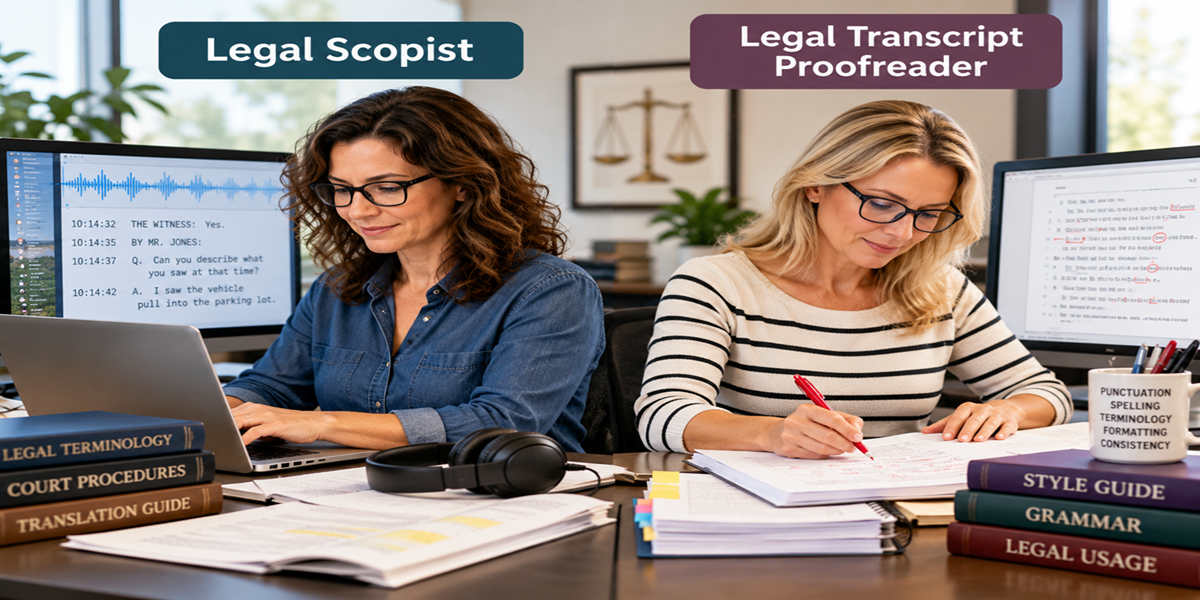
Legal Scopist vs. Legal Transcript Proofreader: What’s the Difference?
A legal scopist and a legal transcript proofreader sound as though they could be the same thing, don’t they? They are not. While both help court reporters produce accurate transcripts, they perform different functions.
The court reporter listens to spoken words and uses a steno machine to record them into shorthand. Computer-aided transcription (CAT) software then translates the shorthand into English.
It would be nice if the raw text were 100% accurate. However, that is not always the case. A scopist reviews the translation and looks for anything out of place. These could be punctuation errors, incorrect formatting, or mistranslations. If necessary, the proofreader picks up the process by performing a quality check after the scopist completes their role.
The exact division of work can vary depending on the court reporter’s workflow.
At first glance, people can confuse these roles because they can sound so similar. Scopists and proofreaders look for errors, but only if the reporter needs them. Both help court reporters produce a polished and accurate final transcript.
But they aren’t interchangeable.
The biggest difference isn’t simply that one edits and the other proofreads. It’s where they work in the transcript-production process and what they’re responsible for checking. Continue reading “Legal Scopist vs. Legal Transcript Proofreader: What’s the Difference?”